
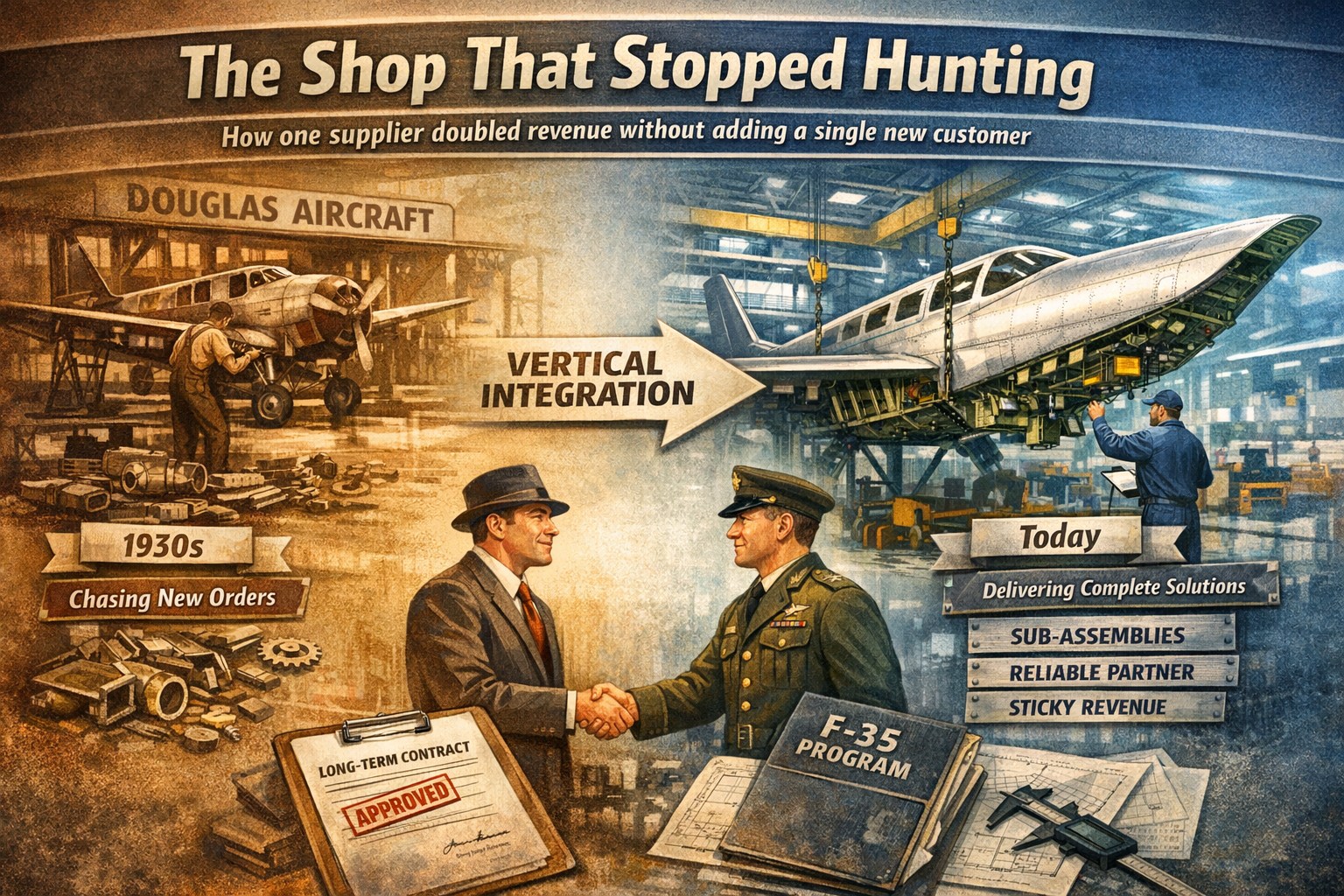
How one supplier doubled revenue without adding a single new customer
In the mid-1930s, as aircraft became more sophisticated, American manufacturers faced a strategic choice. They could continue operating as assemblers, buying machined parts, castings, forgings, and extrusions from dozens of specialized suppliers. Or they could do what the industry’s leaders were quietly beginning to do: vertically integrate, incorporating or controlling all levels of component manufacture and assembly within one organization.
The result was transformative. Companies like Douglas Aircraft didn’t chase new customers. They deepened relationships with existing ones by offering complete sub-assemblies instead of individual components. When Douglas delivered a finished wing section with all hardware installed and all outside processing completed, it wasn’t just selling machined parts anymore. It was selling reliability, coordination, and risk management. The customer got a single point of accountability. Douglas got stickier revenue that competitors couldn’t easily displace.
This vertical expansion wasn’t driven by new technology or breakthrough innovation. It was driven by understanding a simple economic reality: the customer values integration more than they value price optimization across fragmented suppliers. The supplier who eliminates the customer’s coordination burden wins, even at a premium.
Eighty years later, aerospace and defense suppliers face the same strategic choice. They can chase new logos through the grueling Approved Vendor List onboarding process, cybersecurity audits, and learning curve costs that make customer acquisition expensive and slow. Or they can do what Douglas did: grow revenue by capturing more value from relationships they’ve already earned.
The Acquisition Cost Nobody Calculates
In the traditional machine shop model, growth is viewed as a hunting exercise. Owners believe that to increase revenue, they must hire salespeople, attend trade shows, and aggressively bid on RFQs from primes they’ve never worked with before.
In aerospace and defense, this approach is often the least efficient path to scale. Between the Approved Vendor List onboarding process, the required CMMC cybersecurity audits, and the learning curve costs of a new customer’s specific quality standards, the cost of customer acquisition can be staggering. You might spend six months and twenty thousand dollars in qualification costs to win a fifty-thousand-dollar order. The first year is break-even at best.
Meanwhile, the customer who’s been buying one part family from you for three years is sourcing ten other part families from your competitors. Not because you can’t make them. Because they don’t know you can, or because you’ve never systematically asked.
The most successful operators understand this asymmetry. The ones who command the highest multiples from private equity and strategic buyers aren’t the ones with the longest customer lists. They’re the ones who’ve become deeply integrated into a small number of high-value programs.
What Buyers Actually Value
When a sophisticated intermediary or buyer evaluates an aerospace and defense manufacturing business, they aren’t just buying your machines or your current year’s EBITDA. They’re buying future cash flow predictability.
A business that relies on winning the next purchase order every month is high-risk. A business that’s deeply integrated into a ten-year platform like the F-35 or a commercial engine program is a strategic asset. The difference in valuation is enormous. A transactional shop might command five to six times EBITDA. An integrated supplier might command nine to twelve times.
To move your business into the latter category, you must shift your growth strategy from transactional to integrated. This requires three specific moves, none of which involve adding new customers.
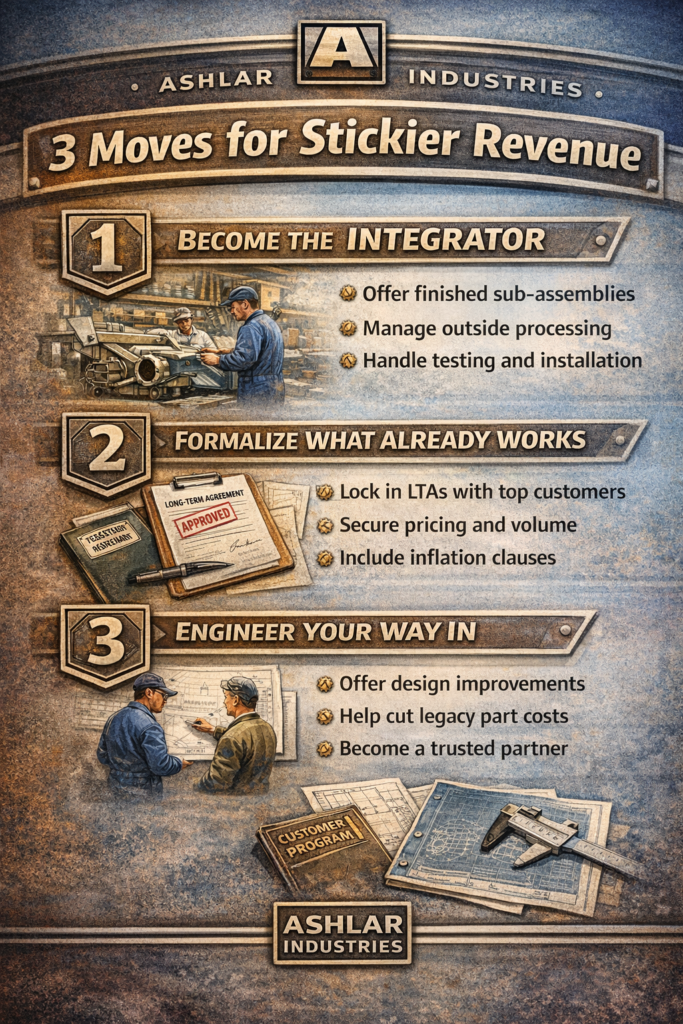
Move One: Become the Integrator
One of the fastest ways to increase revenue is to move up the assembly. Most precision shops are content to ship a machined component. But the primes and tier-ones are on a mission to consolidate their supply chains. They want fewer vendors but deeper partnerships.
The execution is straightforward. Instead of just machining a housing, offer to manage the entire sub-assembly. This includes managing outside processing like NADCAP-certified heat treat, plating, and non-destructive testing. It includes hardware and kitting, sourcing and installing the bushings, pins, or seals required for the next stage of assembly. And where appropriate, it includes testing: performing pressure tests or basic functional checks before the part leaves your dock.
The value capture happens at two levels. By taking on this tier-one responsibility, you can often add a fifteen to twenty percent management fee on top of the outsourced services. You’re not marking up your own labor. You’re being compensated for coordination, quality assurance, and risk management.
More importantly, you become sticky. If a customer is buying a finished sub-assembly from you, it’s ten times harder for them to move that work to a competitor than if they were just buying a standalone machined part. They’d have to recreate your entire supply chain, re-qualify all your sub-tier vendors, and re-document the entire assembly process. Most procurement teams won’t do that to save five percent.
Move Two: Formalize What Already Works
Many aerospace and defense owners pride themselves on handshake deals and decades-long relationships. While these are admirable, they have zero transferable value to a buyer. To a private equity firm, a handshake is a risk. To an owner preparing for exit, an uncontracted relationship is a missed opportunity for both stability and valuation.
The execution requires identifying your bread-and-butter parts, the ones you’ve been running for three or more years with steady demand. Approach the customer with a three-to-five-year Long-Term Agreement proposal. Offer price stability and guaranteed capacity. Ask for minimum volume commitments and right of first refusal on adjacent part numbers.
The critical detail is the inflation clause. Ensure your LTA includes escalators for material price spikes and labor inflation. The mistake most shops make is locking in prices for five years with no protection against input cost increases. That’s not a long-term agreement. It’s a slow-motion margin squeeze.
The value capture is transformative. An LTA transforms your revenue from speculative to contractual. In the mergers and acquisitions world, contractual revenue commands a significantly higher multiple. You’re essentially de-risking the future for a potential buyer, which allows you to exit at a premium. The same fifty million dollars in revenue is worth dramatically more when twenty million of it is locked in through LTAs.
Move Three: Engineer Your Way In
Design for Manufacturability is often treated as a favor the shop floor does for the customer’s engineering team. In reality, it’s a powerful commercial tool that creates preference and locks out competition.
The execution is performing a technical audit of your top customer’s most problematic parts. Look for over-specified tolerances that don’t affect function but kill cycle time. Look for material callouts that are difficult to source or machine. Look for geometries that require expensive custom tooling when standard tooling would work fine.
Present these findings to the customer’s procurement and engineering teams as a cost-out initiative. Show them the data. A tolerance of plus or minus one thousandth might be standard on their drawing, but the part only needs plus or minus three thousandths to function. That difference might cut your cycle time by thirty percent, which translates directly to lower cost.
The value capture is positional. When you save a customer fifteen percent on a legacy program through your engineering expertise, you’re no longer a vendor being compared on price per hour. You’re a strategic partner. This earns you the first look at all new programs, effectively creating a moat around your revenue.
The customer’s engineers start calling you during the design phase, not after the drawing is released. You influence specifications before they’re set in stone. You become part of the development process instead of just a manufacturing service provider. That position is nearly impossible for a competitor to displace.
The Foundation Under Everything
There’s a common saying in aerospace and defense: your best salesperson is your shipping clerk. This is literal. A shop with a ninety-nine percent on-time delivery rating and less than five hundred parts per million quality defects is a unicorn.
Buyers at major defense firms are under immense pressure to avoid supply chain disruptions. If your execution is flawless, they will proactively look for ways to give you more work. They would rather pay a five percent premium to a shop that never misses a delivery than save five percent with a shop that puts their production line at risk.
Reliability is the foundation of revenue expansion. All three moves—integration, formalization, and design partnership—only work if you execute consistently. A customer won’t give you sub-assembly responsibility if you can’t reliably deliver the base component. They won’t sign a long-term agreement if your on-time delivery is erratic. They won’t involve you in design if they don’t trust your technical judgment.
Excellence in execution isn’t a nice-to-have that supports growth. It’s the prerequisite that makes growth possible.
Where the Strategy Breaks
The most common mistake owners make is complexity creep. They add sub-assembly or managed services but fail to update their overhead pricing or quality systems to handle the extra load. They take on integration responsibility without building the operational infrastructure to deliver it reliably.
You cannot build a tier-one integration strategy on top of a disorganized job shop foundation. You need documented workflows for outside processing, standardized LTA review processes, and a clear design-for-manufacturability feedback loop. The chaos that’s tolerable when you’re shipping standalone parts becomes catastrophic when you’re managing assemblies with six sub-tier suppliers.
To grow without adding chaos, you must have operational excellence in place first. The discipline comes before the expansion, not after.
The Pattern Douglas Discovered
Douglas Aircraft didn’t transform its position by hunting for new customers in the 1930s. It did it by asking one simple question: what else can we do for the customers who already trust us? The answer was vertical integration. Instead of selling components, sell complete sub-assemblies. Instead of being one supplier among many, become the integrator who eliminates the customer’s coordination burden.
The aerospace and defense supply chain is under pressure. Lead times are compressing. Primes are consolidating suppliers. The shops that thrive won’t be the ones with the longest customer lists. They’ll be the ones who’ve made themselves indispensable to a concentrated set of high-value programs.
Revenue growth in this environment is about depth, not breadth. By integrating more deeply into your existing customers’ supply chains, you create a more profitable, more stable, and more valuable business. You aren’t just making parts. You’re building an enterprise that’s bankable.
The opportunity isn’t in the next trade show or the next cold call. It’s in the customer who’s been buying from you for five years and doesn’t know you could handle the ten other parts they’re sourcing elsewhere. Find that opportunity. Formalize it. Execute it flawlessly. The revenue multiple takes care of itself.