

How chasing revenue without understanding margin killed a profitable shop in eighteen months
In 1944, a small Cleveland machine shop won what looked like the opportunity of a lifetime. They landed a massive contract from North American Aviation to produce hydraulic components for the P-51 Mustang. The owner celebrated. His employees celebrated. The local newspaper ran a story about the shop’s patriotic contribution to the war effort.
Eighteen months later, the shop was insolvent.
The owner had made a catastrophic error in judgment. He assumed that more revenue naturally led to more profit. The North American contract came with something the commercial work didn’t: byzantine documentation requirements, constant design changes, weekly inspections, and penalty clauses for late delivery. Every dollar of revenue carried twice the administrative burden of his existing work.
By the time the owner understood what was happening, his best machinists were spending half their time in meetings. His machines were running the same utilization hours but producing half the margin. The contract that was supposed to make him rich had consumed his shop’s capacity without generating proportional profit.
The fatal assumption was simple: revenue equals success. In precision manufacturing, particularly in aerospace and defense, this assumption is often exactly backward. Revenue can hide inefficiency. Volume can mask value destruction. The shops that survive long enough to thrive are the ones that learn to distinguish between the work that pays and the work that just keeps people busy.
The Complexity Tax That Never Shows Up
Most machine shops use a standard hourly rate to calculate profitability. If the spindle is turning and the customer is paying one hundred fifty dollars per hour, the job is making money. In aerospace and defense, this logic fails because it ignores the compliance and administrative tax.
A fifty-thousand-dollar order from a commercial client and a fifty-thousand-dollar order from a defense prime do not carry the same cost. The defense contract comes with ITAR and CMMC cybersecurity requirements, the cost of securing data that lives in your systems. It comes with AS9100 and NADCAP documentation, hours spent by the Quality team on First Article Inspection Reports and material certifications. It comes with stringent traceability, the administrative burden of tracking every heat lot and serial number through the entire production process.
Then there’s what operators call the hassle factor. Weekly status calls. Source inspections. Rigid schedule windows that don’t care if your five-axis mill just went down for unplanned maintenance. The customer wants their parts on Tuesday regardless of what else is happening in your shop.
If you’re applying the same overhead rate to both customers, you’re underpricing defense work and overpricing commercial work. The revenue number looks the same on the top line. The margin reality is completely different. Most shops don’t discover this until they’re deep into a contract they can’t afford to fulfill.
The Audit That Reveals the Truth
This is a diagnostic exercise for the owner, GM, or finance lead. You don’t need perfect data to start. Directional clarity is more valuable than accounting purity.
The first step is the fully loaded data pull covering the last twelve months. Gather your data by part number and customer. To get a true picture, you must look beyond material and direct labor. You need direct machine hours showing how long the job actually stayed on the spindle, not just what was quoted. You need the hidden labor: estimated hours spent by Engineering on CAM programming and hours spent by Quality on documentation. You need outside processing costs for NADCAP heat treat, plating, or NDT. And you need rework and scrap costs specifically attributed to that part family.
The second step is calculating contribution margin per spindle hour. This is the golden metric for aerospace and defense shops. Revenue minus variable costs, divided by actual machine hours, equals profitability per hour. When you rank your jobs by this metric, the results are usually shocking.
You’ll often find that prestigious parts from tier-one primes are earning forty dollars per hour after factoring in rework and admin time, while simple legacy parts from unglamorous customers are earning three hundred dollars per hour. The work you brag about at industry conferences is subsidizing your operation. The work you barely think about is funding it.
The third step is segmenting into four quadrants. The engines are your top twenty percent: high margin, low drama. These jobs fund the business. The technical moats are high margin but high complexity. These require your best talent but pay for it. The fill work is low margin, low complexity. These keep the lights on but shouldn’t be the strategic focus. And the margin killers are your bottom twenty percent: high complexity, low margin. These are toxic to your operation.
What Buyers Actually See
If you’re talking to a business broker or private equity intermediary, they’re looking for quality of earnings. A shop with one hundred customers and flat margins is a job shop. A shop that has used this logic to prune its customer base down to fifteen high-performing, high-margin accounts is a strategic platform.
Buyers will pay a higher multiple for a business that shows it has the discipline to say no to unprofitable work. They want to see that your machine capacity is reserved for the work that offers the highest return on invested capital. If your capacity is clogged with low-margin legacy work, a buyer sees that as a management failure they’ll have to fix. And they’ll price your business accordingly.
The difference in valuation is not marginal. A disciplined shop with concentrated, profitable revenue might command eight to ten times EBITDA. A chaotic shop with dispersed, low-margin revenue might struggle to get five times. The revenue number on both shops could be identical. The enterprise value is dramatically different.
The Ninety-Day Pruning Plan
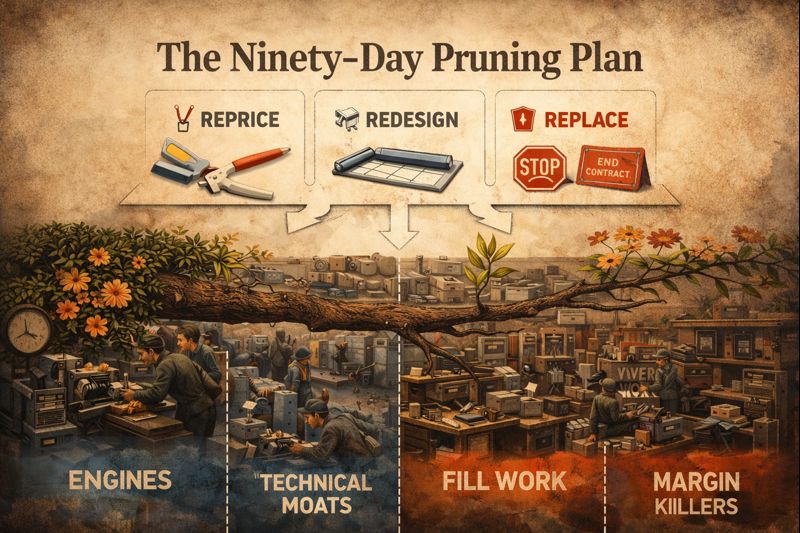
Once the audit is complete, you must take action. Every job in your bottom twenty percent must face one of three fates.
Reprice first. If the job is technically sound but the compliance tax is too high, issue a price increase that reflects the reality of aerospace and defense requirements. If the customer leaves, they’ve done you a favor by freeing up your machines for work that actually generates margin.
Redesign second. Can the part be made more profitably? Work with the customer to change a tolerance or a material callout that makes the part flow through the shop instead of creating constant headaches. Many customers don’t realize their design choices are costing you margin. Show them the data and most will work with you.
Replace third. This is the hardest move for owners. You must explicitly decide to stop taking a specific type of work to make room for the engines. This means telling a customer you’ve served for years that you can no longer support their program at current pricing. It means watching revenue walk out the door in the short term to create capacity for better revenue in the medium term.
Stop carrying unprofitable legacy work out of loyalty to a customer who wouldn’t hesitate to move the work for a five percent price break. Business loyalty is mutual or it’s not loyalty at all.
Where the Fear Breaks Down
The most common failure point is volume fear. Owners worry that if they fire the bottom ten percent of their revenue, they won’t be able to cover their fixed overhead. The factory will go quiet. Employees will be laid off. The business will spiral.
In reality, the opposite happens. When you remove the most chaotic jobs from the floor, lead times for your good customers improve. They notice. They trust you more. They give you more work. Overtime costs drop because there are fewer fires to put out. The Quality team can focus on prevention rather than documenting failures. The shop becomes more predictable, more reliable, more pleasant to work with.
The lost revenue is almost always replaced by higher-margin work because your shop is now more responsive and dependable. Customers value reliability more than they value the lowest possible price. When you demonstrate that you can deliver on time without drama, you become the supplier they call first when they have critical work.
The capacity you free up by eliminating margin killers gets filled by engines. Not immediately. Not always in the first quarter. But consistently, over time, as your reputation for execution compounds.
The Pattern Owners Never See
The Cleveland shop owner didn’t lose his shop because he was incompetent. He lost it because he confused revenue with value. The North American Aviation contract was real revenue. It just wasn’t profitable revenue. By the time he understood the difference, his best customers had moved on to suppliers who could still deliver predictably.
The shops that thrive in aerospace and defense aren’t the ones with the biggest top lines. They’re the ones that understand complexity is a cost that must be priced. The audit isn’t optional for shops that want to scale or exit at a meaningful multiple. It’s the only way to ensure you aren’t subsidizing a prime’s difficult engineering at the expense of your own equity value.
In a precision environment where every spindle hour has an opportunity cost, the discipline isn’t in saying yes to more work. It’s in saying no to the wrong work. The shops that master this distinction don’t grow by chasing contracts. They grow by protecting capacity for the customers who value what they do and pay accordingly.
Revenue is a vanity metric. Margin is a survival metric. The difference between the two is the difference between the Cleveland shop owner’s fate and the fate of the shops that outlasted him. Choose accordingly.
Subscribe to receive Growth Without Chaos, our upcoming playbook for A&D operators who’ve discovered that the fastest path to revenue isn’t new machines or new markets, but eliminating the dead time between decisions.