
How breaking the rules of quote turnaround became the fastest path to revenue growth
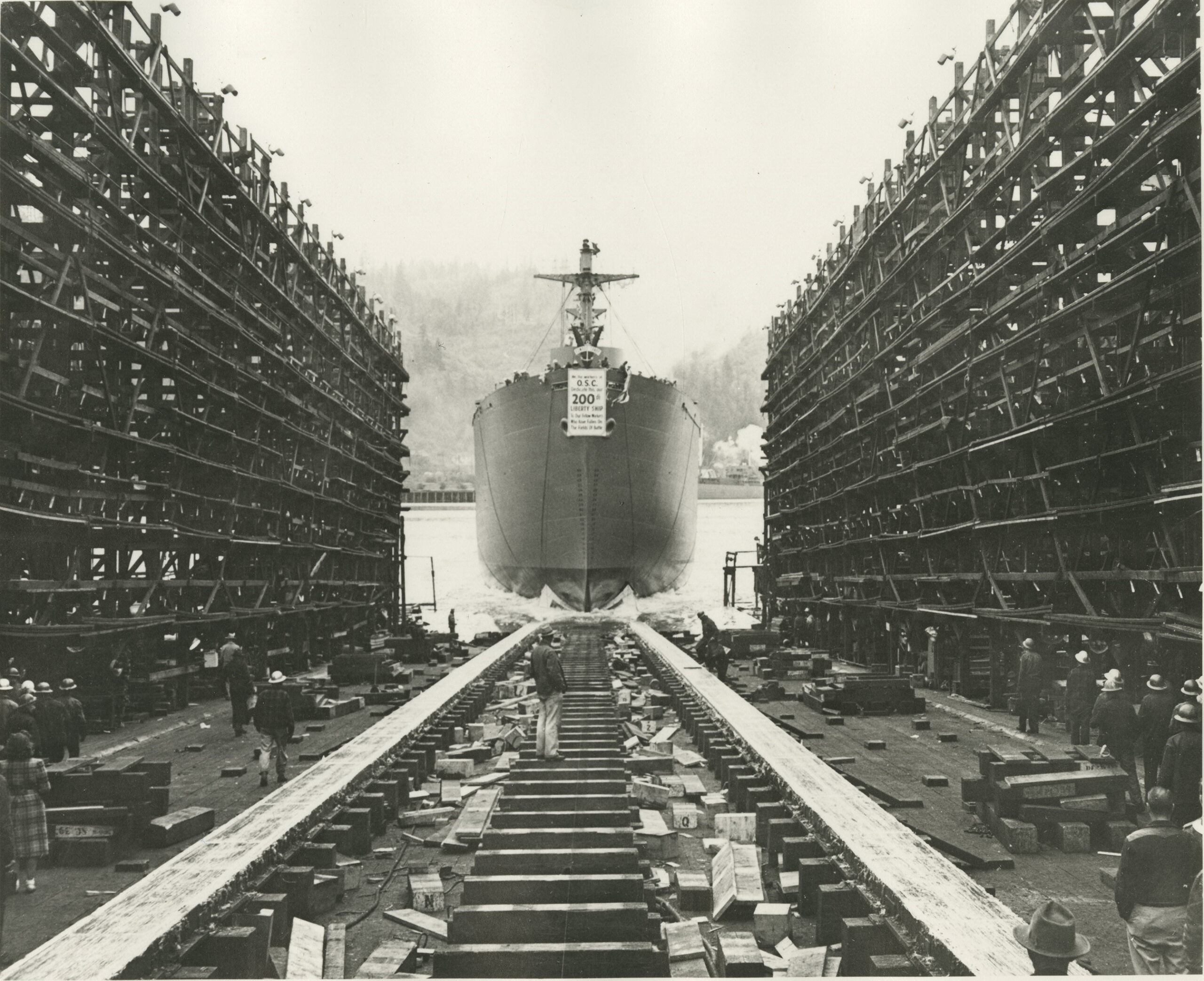
In the spring of 1942, Henry Kaiser’s shipyards faced a problem that should have been impossible to solve. The U.S. Navy needed Liberty ships faster than any shipyard in history had ever built them. Traditional shipbuilders said it couldn’t be done. Kaiser had none of their advantages.
His answer wasn’t better welders or bigger cranes. It was something more fundamental: he eliminated the dead time between decisions.
While competitors spent weeks engineering perfect solutions, Kaiser’s teams made fast calls with acceptable data and moved on. By 1943, his yards were launching a ship every day. The breakthrough wasn’t technical. It was operational. Kaiser understood that in industrial environments, time between decisions is often more expensive than the decisions themselves.
The traditional shipbuilders were right that Kaiser’s methods weren’t perfect. They were wrong that perfection mattered more than speed. In a crisis, good enough delivered fast beats perfect delivered late.
Eighty years later, precision machine shops face a structurally similar problem: the gap between when a customer asks for a quote and when they get an answer that lets them move forward. Most shops treat this gap as unavoidable friction. A handful have learned it’s the highest-leverage point in their entire operation.
The Orthodoxy and Its Costs
Machine shop owners are routinely told that growth requires new customers, new equipment, or new markets. The industry’s default playbook is expansion: more capacity, more capabilities, more reach. This advice isn’t wrong. It’s just expensive, slow, and often unnecessary for shops that haven’t maximized what they already have.
The pattern that emerges from shops that grow profitably is different. Revenue acceleration comes from tightening execution inside the business, not expanding externally. The constraint isn’t market opportunity. It’s operational discipline.
Precision manufacturing operates in a distinctive commercial environment. Customers don’t always award work to the lowest bidder. They often award it to the first acceptable bidder. Speed compounds into market share in ways that pricing alone cannot. A buyer with an urgent need doesn’t wait for all three quotes to compare pricing. They move forward with whoever answers first at a reasonable price.
Yet most shops still operate as if quote quality matters infinitely more than quote speed, even for work they’ve done a dozen times before. Every request triggers the same elaborate estimation process. This makes sense for genuinely new work. It makes no sense for repeat parts that represent the majority of quoting activity.
The result is predictable: capable shops lose work to inferior competitors who simply answer faster. Revenue growth stalls despite full order books. Owners work seventy-hour weeks to grow five percent.
Five Levers, Ninety Days
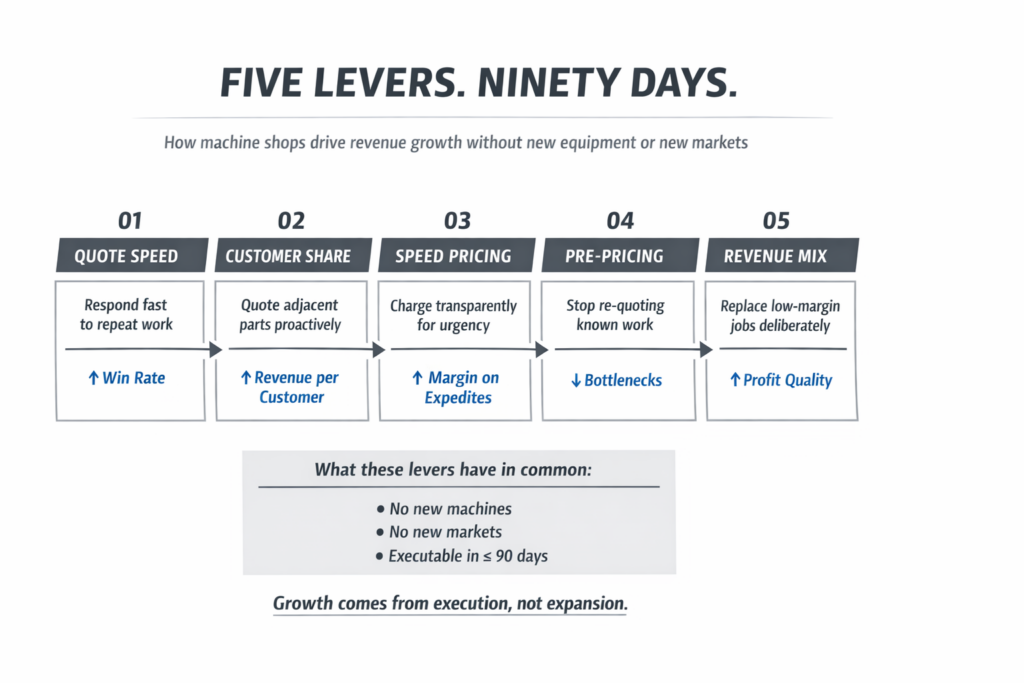
The fastest revenue gains come from five levers that share two characteristics: high impact and realistic execution within ninety days. No new equipment required. No market expansion. Just operational rewiring that most shops resist because it requires breaking comfortable habits.
First: Kill the Quote Death Spiral
The strongest predictor of win rate in job-shop environments isn’t price. It’s response time. Industry data shows that shops responding within forty-eight hours report materially higher conversion than those responding after a week. This isn’t marginal. It’s the difference between winning half your quotes and winning three-quarters of them.
Buyers award work to the first acceptable quote because delay has its own cost. They’re not optimizing for your perfection. They’re optimizing for their own schedule.
Most shops treat every request for quote as a unique engineering problem requiring custom estimation. The insight that changes everything: most quotes aren’t unique. Pull the last six months of RFQs and classify them honestly. Sixty to seventy percent are repeat parts or similar families. These don’t need custom estimates. They need standard assumptions and default pricing.
The implementation is straightforward. Segment requests into repeat work, similar families, and genuinely new complexity. For repeat families, document standard assumptions for setup time, cycle time, and margin bands. Then flip the approval logic: require justification to delay a quote, not to issue one quickly. Make speed the default and precision the exception.
Track three metrics weekly: quotes issued, average turnaround time, and win rate. Most shops see results within six weeks.
The discipline this requires is saying no to comfortable behaviors. Stop custom-estimating repeat parts. Stop waiting for perfect routing data. Stop treating every quote as if it requires engineering review when the real risk is never getting the chance to prove yourself because someone else answered first.
What breaks this lever is treating every quote as unique and allowing estimating perfection to override commercial speed. The shops that win prioritize acceptable answers delivered fast over perfect answers delivered late.
Second: The Revenue Hidden in Plain Sight
Many precision suppliers capture only a fraction of a customer’s total addressable spend. Not because they can’t do the work, but because customers don’t know what else the supplier can do. The constraint isn’t performance. It’s awareness.
This is fixable with disciplined execution. Start by building a capability fact base: machining processes, tolerances, materials, certifications, and secondary operations you actually perform today. Then map your top ten customers against that list. For each customer, document current parts supplied and identify adjacent parts you could already support without adding capability.
The operational rule: each top customer gets at least one proactive adjacent quote per month. Not a sales pitch. An actual quote for work you know they’re buying elsewhere that you could deliver tomorrow.
This isn’t about expanding what you do. It’s about capturing more of what you already do well. Customers prefer to consolidate suppliers when the existing supplier can demonstrably handle adjacent work. You’re not asking them to take a risk. You’re asking them to reduce their own overhead.
The mistake most shops make is treating this as a one-time sales exercise. The shops that succeed make it operational rhythm, not episodic effort.
Third: Charge What Speed Actually Costs
Industrial customers will pay meaningful premiums for speed when urgency is real, but only when pricing is transparent and predictable. Many shops already expedite work. Few do it profitably or systematically.
The fix is defining lead-time tiers with explicit premiums. Standard lead time carries baseline pricing. Expedited lead time carries a clearly defined premium that reflects overtime, rescheduling costs, and displacement of other work. The premium isn’t a penalty. It’s the cost of priority.
What makes this work is positioning. Train the front line to present speed as a premium service, not a grudging favor. The customer isn’t being punished for urgency. They’re buying a capability that has real cost.
What breaks this lever is fear of upsetting customers and inconsistent application. The shops that succeed apply premium pricing uniformly and transparently. They price disruption honestly and let customers decide if the speed is worth the cost.
The result: expedited work stops destroying margin and starts generating it. Customers get predictable options instead of unpredictable reactions.
Fourth: Stop Re-Quoting What You Already Know
Re-quoting repeat work is a self-inflicted bottleneck that adds no value. If you’ve made a part three times with stable drawings and predictable volumes, you don’t need to estimate it again. You need pricing bands based on material variability and volume breaks, updated quarterly instead of per order.
Focus on parts with stable drawings, predictable volumes, and low engineering change frequency. Establish acceptable price ranges. Review them periodically, not transactionally. The time saved compounds into the conversion advantage described earlier.
The mistake that prevents this from working is over-engineering pricing precision and failing to revisit assumptions when costs change. Treat pre-pricing as a living system that gets smarter over time, not a one-time setup.
Fifth: Replace Revenue, Don’t Just Add It
Revenue mix matters more than total revenue. This is the hardest truth because it requires saying no to money that’s already coming in. Industry profitability benchmarks consistently show that chasing volume without margin clarity degrades performance.
The operational sequence is straightforward but emotionally difficult. Rank jobs by contribution margin, including labor, machine time, material, rework, expedite costs, and management attention. Diagnose root causes: is the issue pricing, setup complexity, or customer behavior? Then decide deliberately. Each low-margin job must be repriced, redesigned, or replaced.
Replacing low-margin work requires carrying the short-term revenue gap while higher-margin opportunities fill the freed capacity. This is why most shops don’t do it. The discipline is trusting that freed capacity will attract better work.
What makes this work is refusing to carry unprofitable legacy work by default and having difficult customer conversations early. Every unprofitable job consumes management time and resources that could be spent on profitable growth. The opportunity cost is invisible until you make it visible.
Start With One Thing
If time and bandwidth are limited, start with quote turnaround time for repeat work. This lever has the fastest feedback loop, the lowest risk, and the highest impact per hour invested. Many shops see results within weeks. It builds momentum for harder changes.
The operating cadence that makes all five levers work: a thirty-minute weekly review with the same agenda every week. Metrics versus target. What moved this week. What’s blocked and by whom. One decision to unblock progress.
This isn’t sophisticated. It’s disciplined. The shops that grow without chaos don’t have better systems. They have tighter feedback loops and faster decisions.
The Pattern Behind the Levers
Henry Kaiser didn’t invent welding or steel fabrication. He eliminated the delays between decisions that made both less effective. The machine shops that grow fastest in 2026 aren’t the ones with the newest CNCs or the most aggressive sales teams. They’re the ones that closed the gap between quote and cut, between capability and customer awareness, between cost and price.
The aerospace and defense supply chain is under pressure from nearshoring mandates, supply chain fragility, and the urgent need for reliable precision suppliers. The shops that thrive won’t be the biggest. They’ll be the ones that answer fast, deliver predictably, and know their numbers cold.
This requires breaking comfortable habits: exhaustive quoting for repeat work, passive customer relationships, inconsistent expedite pricing, tolerance for low-margin legacy revenue. These habits feel safe because they’re familiar. They’re expensive because they’re slow.
The opportunity isn’t in new markets or new machines. It’s in the dead time between decisions that costs more than the decisions themselves. Closing that gap doesn’t require capital. It requires discipline, clarity, and the willingness to operate differently than the shop down the street that’s still waiting for the perfect quote to send out next week.
Growth without chaos isn’t about working harder. It’s about eliminating the friction that makes hard work less effective. The shops that understand this don’t grow by accident. They grow by design.
Subscribe to receive Growth Without Chaos, our upcoming playbook for A&D operators who’ve discovered that the fastest path to revenue isn’t new machines or new markets, but eliminating the dead time between decisions.